Loading
Loading

Jeep originated from a US Army requirement in 1940 for a lightweight, four-wheel-drive reconnaissance vehicle. The contract was awarded to Willys-Overland, and the Willys MB, along with the similar Ford GPW, became the iconic World War II utility vehicle. The name Jeep is widely believed to derive from the military designation GP (General Purpose), though this etymology is disputed.
After the war, Willys-Overland trademarked the Jeep name and began producing civilian versions, the CJ (Civilian Jeep). The CJ evolved through several generations and directly led to the Jeep Wrangler in 1986. Kaiser purchased Willys in 1953 and continued Jeep production. American Motors Corporation (AMC) bought Kaiser Jeep in 1970 and developed the first Jeep Cherokee (SJ) in 1974, which is often credited as the first modern SUV.
Chrysler purchased AMC in 1987 primarily to acquire the Jeep brand, recognizing its value. Jeep has since been owned by DaimlerChrysler, Cerberus Capital Management, and is now part of Stellantis. The brand has expanded from its off-road roots into a full SUV and crossover lineup, including the Wrangler, Grand Cherokee, Cherokee, Compass, Renegade, and Wagoneer.
[Note: Jeep uses the brand name to refer to multiple legacy models. The four-wheel-drive system designations include Command-Trac, Rock-Trac, Quadra-Trac, and Selec-Trac, which vary by model and generation in terms of capability and complexity.]
The original Willys MB established the template for the light military utility vehicle, with its compact dimensions, four-wheel drive, fold-down windshield, and ability to carry a driver, three passengers, and equipment. This design influenced every subsequent military utility vehicle globally.
The Jeep Cherokee (XJ, 1984) was the first SUV to use a unibody construction rather than body-on-frame, setting a precedent that most modern SUVs and crossovers follow. It was also the first American vehicle with a full-time four-wheel-drive system that could be used on paved roads.
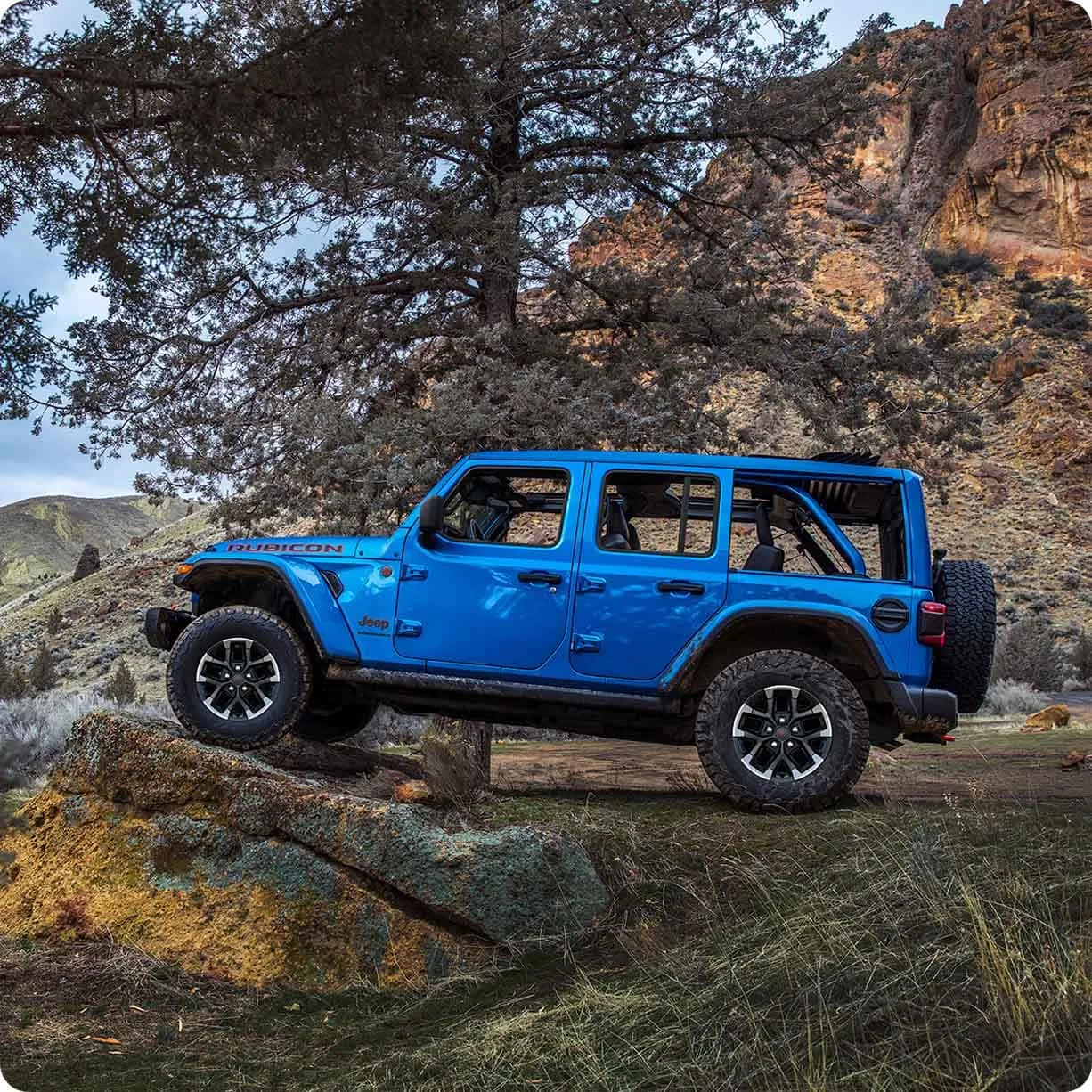
The Jeep Wrangler has maintained its fundamental design since 1986: solid front and rear axles, a ladder frame, removable doors, a fold-down windshield, and a choice of soft or hard tops. This adherence to off-road authenticity while adding modern amenities has kept the Wrangler relevant for decades while direct competitors moved to unibody construction.
The Jeep Wrangler 4xe plug-in hybrid (2021) was the first plug-in hybrid off-road SUV, combining electric driving capability with Jeep traditional four-wheel-drive hardware. It became the best-selling plug-in hybrid vehicle in the US market.
The Quadra-Drive II system introduced on the Grand Cherokee used three electronic limited-slip differentials and a two-speed transfer case, providing what Jeep called the most advanced four-wheel-drive system in the world at its introduction.
The Willys MB, the original Jeep, entered US military service as the World War II light reconnaissance vehicle.
Willys-Overland introduced the CJ-2A, the first civilian Jeep, marking the beginning of Jeep as a consumer brand.
The Jeep Cherokee (SJ) was introduced, often credited as the first modern SUV with its full-length roof and four doors.
The Jeep Wrangler (YJ) replaced the CJ series, introducing square headlights and a wider track while maintaining off-road capability.
The first plug-in hybrid Wrangler launched, combining Jeep off-road capability with electric power.
How the platform works for buyers and dealers